Some of the websites I found useful during my research of the Art Nouveau project were:
http://www.vam.ac.uk/content/articles/a/art-deco-design-influences/
I found this link helpful in finding out about how Art Nouveau movement has influenced the art world today and the importance of it.
http://www.theartstory.org/movement-art-nouveau.htm
I found this link helped me in finding out the history and background of the movement.
http://www.bbc.co.uk/homes/design/period_artnouveau.shtml
This link helped me with the styles of art nouveau and I found out a few artists who were part of the art nouveau movement.
http://www.metmuseum.org/toah/hd/artn/hd_artn.htm
This link provided me with some images and also some more history and background on the movement and also a bit more about the influences it had.
https://en.wikipedia.org/wiki/Art_Nouveau
Again this link gave me some of the background and the origins of where it began and some important artists and architectures during the movement.
http://www.apartmenttherapy.com/quick-history-art-nouveau-142976
This provided me with some images and some information on the different influences of the specific categories of the movement.
http://www.senses-artnouveau.com/art_nouveau.php
This gave me more history, influences, artists, information on jewellery and other processes that were involved during the movement.
I found a lot of my images on google or through these websites. I also took some information from a couple of books:
"Art Nouveau" by Norbert Wolf
"Alphonse Mucha " by Sarah Mucha
I found all of these links and books very helpful and informative in finding all the information I required to complete my project.
Monday, 20 May 2013

Art Nouveau: Influences
Although the Art Nouveau movement had a rapid decline because after the 1910 it already vanished, its importance in applied arts and architecture remains overwhelming. We can say that this style has every right to hold a great place in the history of art, especially in the history of art styles.
The Art Nouveau movement had a great influence on illustrators, artists and the printing trade in America including Art Nouveau revivial in the post-war 60s hippie movement. Even today, some of the best features of Art Nouveau can be seen throughout the visual communication industry – like the painting of Marilyn Monroe for “Visages De Renom” by New York illustrator Les Katz or the works of Milton Glaser and his Push-Pin studio.

The Art Nouveau movement had a great influence on illustrators, artists and the printing trade in America including Art Nouveau revivial in the post-war 60s hippie movement. Even today, some of the best features of Art Nouveau can be seen throughout the visual communication industry – like the painting of Marilyn Monroe for “Visages De Renom” by New York illustrator Les Katz or the works of Milton Glaser and his Push-Pin studio.

The Art Nouveau has been reevaluated in the last twenty years with the rise of postmodernism design. Artists all over the world are using as inspiration today elements of this modern art style like the sinuous lines, floral elements, the nature features and the characteristic colors.
A lot of the Art nouveau architecture still stands around the world and artists have been made famous by this style. Art nouveau has had a great influence on contemporary culture today and the art, fashion and architecture that remains will always be a reminder of the movement and the beautiful style it brought to the world.
Sunday, 19 May 2013
Merry Wives- Finito!
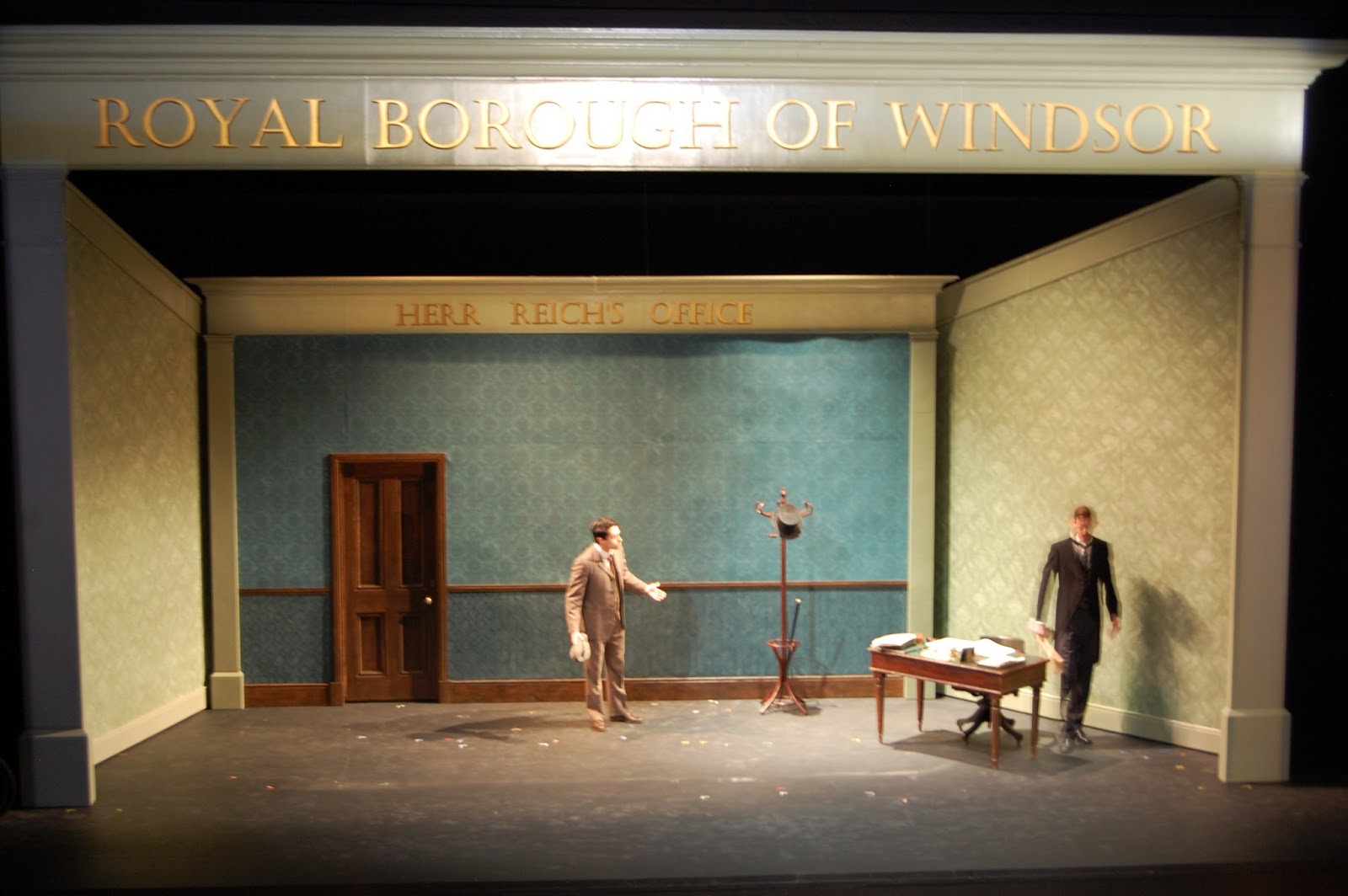
Merry wives is now finally finished! The set looked absolutely stunning on stage and I was really pleased with the outcome. Everyone worked really hard and we created a beautiful show...the singing was alright too...haha.


My family came to see it and really enjoyed it and even said the 3 hours flew by. Unfortunately my Edinburgh friends didn't feel the need to support me, as usual.
But hey, its their loss, you learn who your true friends are when you come to uni and meet people like you. I was home at the weekend as my sister just got a job in London so we were having a wee get together to say bye to her. I had a really good chat with my mum and she helped me put a real perspective on my life and made me think about a lot of things and im feeling really positive about the changes I need to make in my life to make me happier. Im actually looking forward to moving home in the summer, since my sister wont be there (don't get me wrong I love her to bits but I couldn't live with her again) I really think my mum and I will get on and I do miss her and as much as I don't like to say it, she is usually right and I think she'll help me see things clearly once I graduate.
Im slowly getting there with all my paperwork. We've got a cloth to paint for Hazel this week, although i've not seen the cloth about...and i've also not even seen the model! Going to start my Agnes Cecil painting on Monday so i'll hopefully get that finished maybe this week or next, hopefully in time for grad show!



My family came to see it and really enjoyed it and even said the 3 hours flew by. Unfortunately my Edinburgh friends didn't feel the need to support me, as usual.
But hey, its their loss, you learn who your true friends are when you come to uni and meet people like you. I was home at the weekend as my sister just got a job in London so we were having a wee get together to say bye to her. I had a really good chat with my mum and she helped me put a real perspective on my life and made me think about a lot of things and im feeling really positive about the changes I need to make in my life to make me happier. Im actually looking forward to moving home in the summer, since my sister wont be there (don't get me wrong I love her to bits but I couldn't live with her again) I really think my mum and I will get on and I do miss her and as much as I don't like to say it, she is usually right and I think she'll help me see things clearly once I graduate.
Im slowly getting there with all my paperwork. We've got a cloth to paint for Hazel this week, although i've not seen the cloth about...and i've also not even seen the model! Going to start my Agnes Cecil painting on Monday so i'll hopefully get that finished maybe this week or next, hopefully in time for grad show!
Art Nouveau: Furniture & Theatre
Furniture & Accessories
In general, the furniture pieces had round, sinuous and elegant lines. The furniture has made out of wood usually combined with glass and metal. Some furniture pieces had tapestry and stylish floral patterns. The cabinets regularly had many drawers and painted glasses.
 The chairs in an Art Nouveau decorated house had high backrests and the tables were low and most often had the countertop made out of colored glass. Actually, the painted glass and the stained glass are defining elements for this style. It is used in making decorative objects, lamps or for embedded panels in the furniture or in the windows of doors.


Theatre

An important element of the new theatre movement was cabaret. The works of Ernst von Wolzogen, the pioneering German exponent of this art form, who gave guest performances with his ‘Buntes Theater’ in Landau, Frank Wedekind, Arnold Schönberg and the young Pablo Picasso represent driving forces behind the development of cabaret.

In general, the furniture pieces had round, sinuous and elegant lines. The furniture has made out of wood usually combined with glass and metal. Some furniture pieces had tapestry and stylish floral patterns. The cabinets regularly had many drawers and painted glasses.


Art Nouveau artists were convinced that their new designs for life should be pervasive. Theatre culture, that is, the theatre, was also part of this fascinating movement for renewal. At the 1900 Paris Exposition, the dancer Loïe Fuller captivated the public with her performances in floating garments. In Moscow the legendary Ballets russes was founded and Max Reinhardt became the star stage director in Berlin. Versatile and prolific artists such as Edvard Munch and Peter Behrens contributed expressive stage scenery. The author of the present publication reveals background material that ranges from the ideal of beauty cultivated by Oscar Wilde, who scandalised the reading public of his day, to the celebrated balletic performances of Nijinsky’s in Paris: the beginnings of modern theatre.

One might assume that theatres were only built in big cities. However, in the Art Nouveau era impressive theatres went up – designed by such luminaries as Hector Guimard, Henry van de Velde and Heinrich Tessenow – not just in Paris and Cologne but also in Hellerau (near Dresden), Pfullingen (near Reutlingen) and Landau in Rhineland-Palatinate. The present book is published to commemorate the centenary of the Art Nouveau Festival Hall in Landau, designed by the architect Hermann Goerke.
 |
| Amsterdam theatre |

Saturday, 18 May 2013
Art Nouveau: Art
There are many Art Nouveau artist who have been a big influence on the art world with their unique art nouveau style. To name a few;
Alphonse Maria Mucha
Was born in the town of Ivancice, Moravia (today's region of Czech Republic). His singing abilities allowed him to continue his education through high school in the Moravian capital of Brünn (today Brno), even though drawing had been his first love since childhood. He worked at decorative painting jobs in Moravia, mostly painting theatrical scenery, then in 1879 moved to Vienna to work for a leading Viennese theatrical design company, while informally furthering his artistic education. When a fire destroyed his employer's business in 1881 he returned to Moravia, doing freelance decorative and portrait painting. Count Karl Khuen of Mikulov hired Mucha to decorate Hrusovany Emmahof Castle with murals, and was impressed enough that he agreed to sponsor Mucha's formal training at the Munich Academy of Fine Arts.

 Mucha produced a flurry of paintings, posters, advertisements, and book illustrations, as well as designs for jewellery, carpets, wallpaper, and theatre sets in what was initially called the Mucha Style but became known as Art Nouveau (French for 'new art'). Mucha's works frequently featured beautiful healthy young women in flowing vaguely Neoclassical looking robes, often surrounded by lush flowers which sometimes formed haloes behind the women's heads. In contrast with contemporary poster makers he used paler pastel colors. The 1900 Universal Exhibition in Paris spread the "Mucha style" internationally, of which Mucha said "I think [the Exposition Universelle] made some contribution toward bringing aesthetic values into arts and crafts." He decorated the Bosnia and Herzegovina Pavilion and collaborated in the Austrian Pavilion. His Art Nouveau style was often imitated. However, this was a style that Mucha attempted to distance himself from throughout his life; he insisted always that, rather than adhering to any fashionable stylistic form, his paintings came purely from within and Czech art. He declared that art existed only to communicate a spiritual message, and nothing more; hence his frustration at the fame he gained through commercial art, when he wanted always to concentrate on more lofty projects that would ennoble art and his birthplace.


Gustrav Kilmt
Born in 1862,Austrian painter Gustav Klimt was Vienna's most renowned advocator of Art Nouveau,. He is remembered as one of the greatest decorative painters of the twentieth century, and he also produced one of the century's most significant bodies of erotic art. Initially successful as a conventional academic painter, his encounter with more modern trends in European art encouraged him to develop his own eclectic and often fantastic style. His position as the co-founder and first president of the Vienna Secession also ensured that this style would become widely influential - though Klimt's direct influence on other artists was limited. He never courted scandal, but it dogged his career, and although he never married, he is said to have fathered fourteen children.

.jpg)
Klimt first achieved acclaim as a conventional academic painter, and received many commissions to paint public buildings. He later abandoned both the realism, and the approach to historical subject matter, that were characteristic of the 19th century. However, his interest in the decorative possibilities of painting could be seen as typical of the period's love of grandeur and elaboration. It might also be interpreted as an attempt to reconcile the natural and the artificial, a typical preoccupation of the 19th century, as modern technology began to transform the world beyond recognition.


William Bradley
Will Bradley (1868-1962) is widely regarded as one of the masters of design during the Art Nouveau and Arts & Crafts periods. His typographic and illustrative work pushed the boundaries of these fields into new directions. In addition, his re-introduction and use of Caslon type brought it back into popularity. William Bradley was one of the masters of book, poster and magazine design. He lived during time period when Art Nouveau and Arts and Crafts movement had to say a lot to all artists.


Alphonse Maria Mucha
Was born in the town of Ivancice, Moravia (today's region of Czech Republic). His singing abilities allowed him to continue his education through high school in the Moravian capital of Brünn (today Brno), even though drawing had been his first love since childhood. He worked at decorative painting jobs in Moravia, mostly painting theatrical scenery, then in 1879 moved to Vienna to work for a leading Viennese theatrical design company, while informally furthering his artistic education. When a fire destroyed his employer's business in 1881 he returned to Moravia, doing freelance decorative and portrait painting. Count Karl Khuen of Mikulov hired Mucha to decorate Hrusovany Emmahof Castle with murals, and was impressed enough that he agreed to sponsor Mucha's formal training at the Munich Academy of Fine Arts.

 Mucha produced a flurry of paintings, posters, advertisements, and book illustrations, as well as designs for jewellery, carpets, wallpaper, and theatre sets in what was initially called the Mucha Style but became known as Art Nouveau (French for 'new art'). Mucha's works frequently featured beautiful healthy young women in flowing vaguely Neoclassical looking robes, often surrounded by lush flowers which sometimes formed haloes behind the women's heads. In contrast with contemporary poster makers he used paler pastel colors. The 1900 Universal Exhibition in Paris spread the "Mucha style" internationally, of which Mucha said "I think [the Exposition Universelle] made some contribution toward bringing aesthetic values into arts and crafts." He decorated the Bosnia and Herzegovina Pavilion and collaborated in the Austrian Pavilion. His Art Nouveau style was often imitated. However, this was a style that Mucha attempted to distance himself from throughout his life; he insisted always that, rather than adhering to any fashionable stylistic form, his paintings came purely from within and Czech art. He declared that art existed only to communicate a spiritual message, and nothing more; hence his frustration at the fame he gained through commercial art, when he wanted always to concentrate on more lofty projects that would ennoble art and his birthplace.

Gustrav Kilmt
Born in 1862,Austrian painter Gustav Klimt was Vienna's most renowned advocator of Art Nouveau,. He is remembered as one of the greatest decorative painters of the twentieth century, and he also produced one of the century's most significant bodies of erotic art. Initially successful as a conventional academic painter, his encounter with more modern trends in European art encouraged him to develop his own eclectic and often fantastic style. His position as the co-founder and first president of the Vienna Secession also ensured that this style would become widely influential - though Klimt's direct influence on other artists was limited. He never courted scandal, but it dogged his career, and although he never married, he is said to have fathered fourteen children.

.jpg)
Klimt first achieved acclaim as a conventional academic painter, and received many commissions to paint public buildings. He later abandoned both the realism, and the approach to historical subject matter, that were characteristic of the 19th century. However, his interest in the decorative possibilities of painting could be seen as typical of the period's love of grandeur and elaboration. It might also be interpreted as an attempt to reconcile the natural and the artificial, a typical preoccupation of the 19th century, as modern technology began to transform the world beyond recognition.


William Bradley
Will Bradley (1868-1962) is widely regarded as one of the masters of design during the Art Nouveau and Arts & Crafts periods. His typographic and illustrative work pushed the boundaries of these fields into new directions. In addition, his re-introduction and use of Caslon type brought it back into popularity. William Bradley was one of the masters of book, poster and magazine design. He lived during time period when Art Nouveau and Arts and Crafts movement had to say a lot to all artists.

He was born in Boston, Massachusetts, and at the age of 12 he obtained a job as a printer for a weekly newspaper. He later left for Chicago, Illinois, where he held a few brief jobs as a wood engraver and typographer before dedicating himself to freelance graphic design. He moved back to Massachusetts and set up the Wayside Press, where he served as an illustrator, editor, typographer, designer, and press manager for a periodical aptly named Bradley: His Book. The periodical usually contained compilations of poetry, stories, and sketches, and his work received a warm reception. He had achieved financial success, but the stress of managing so many projects at once began to damage his health, and he collapsed at the age of 28. He recovered quickly, but he was forced to sell the Wayside Press. He later worked as a consultant for the American Type Founders and as an editor for Collier's Weekly. He worked briefly with children’s books, then for William Randolph Hearst’s film division as a set designer. In 1954, Bradley published a memoir of his life, called Bradley: His Chap Book, though only 650 copies were ever published. The same year, he won the AIGA award, the highest honor for graphic designers. He was a prolific artist and designer up until his death at age 94.


Tuesday, 7 May 2013
Bits and bobs
We've had quite a few wee notes for opera over the last couple of weeks, a few chairs to be wood-grained here, a sign to be made there, its never ending! But the end is almost in sight. All the set is now finally down the road. We had a paintcall last week and had a huge list of things, we managed to get the most of it done but a couple of things went wrong due to bad communication, not on my behalf but I did of course get the blame. It was a pretty stressful night for me just because we had such a big list of things but only a small amount of time. We did pretty well though and got the majority of the list ticked off.
We've been working on the tron shows the last week and have been doing some work on Sophies floor cloth, it's looking pretty good, although its getting pretty trampled being on the floor. Started working on Possibilities today too and Saz, Rose and myself stayed late to work on the turrets for the west end festival, they're looking pretty good :)
We had a bit of time to do personal projects at the end of last week. I started a portrait of myself in the style of an artist called Agnes Cecil. I had planned to combine a couple of her painting styles into my portrait.
 I was quite happy with what i had produced in the day I was working on it but then realised that adding one of the styles would take away from my painting and I hadn't really captured the same style that she used so after talking to Gary we decided it would be best if i started again and used a different composition and zoomed in so that i was just painting my face and not any of my torso. I spend half a day on that but just couldn't get the style right and Gary said i was giving myself too much work trying to replicate a picture in the style of a different one so suggested that I just copy the painting which I was using for the style so that i can capture how to create that style then I can try and combine it with a different picture. I think we'll have some time to work on personal projects at the end of this week so im hoping to make a lot of progress on this one.

We've been working on the tron shows the last week and have been doing some work on Sophies floor cloth, it's looking pretty good, although its getting pretty trampled being on the floor. Started working on Possibilities today too and Saz, Rose and myself stayed late to work on the turrets for the west end festival, they're looking pretty good :)
We had a bit of time to do personal projects at the end of last week. I started a portrait of myself in the style of an artist called Agnes Cecil. I had planned to combine a couple of her painting styles into my portrait.
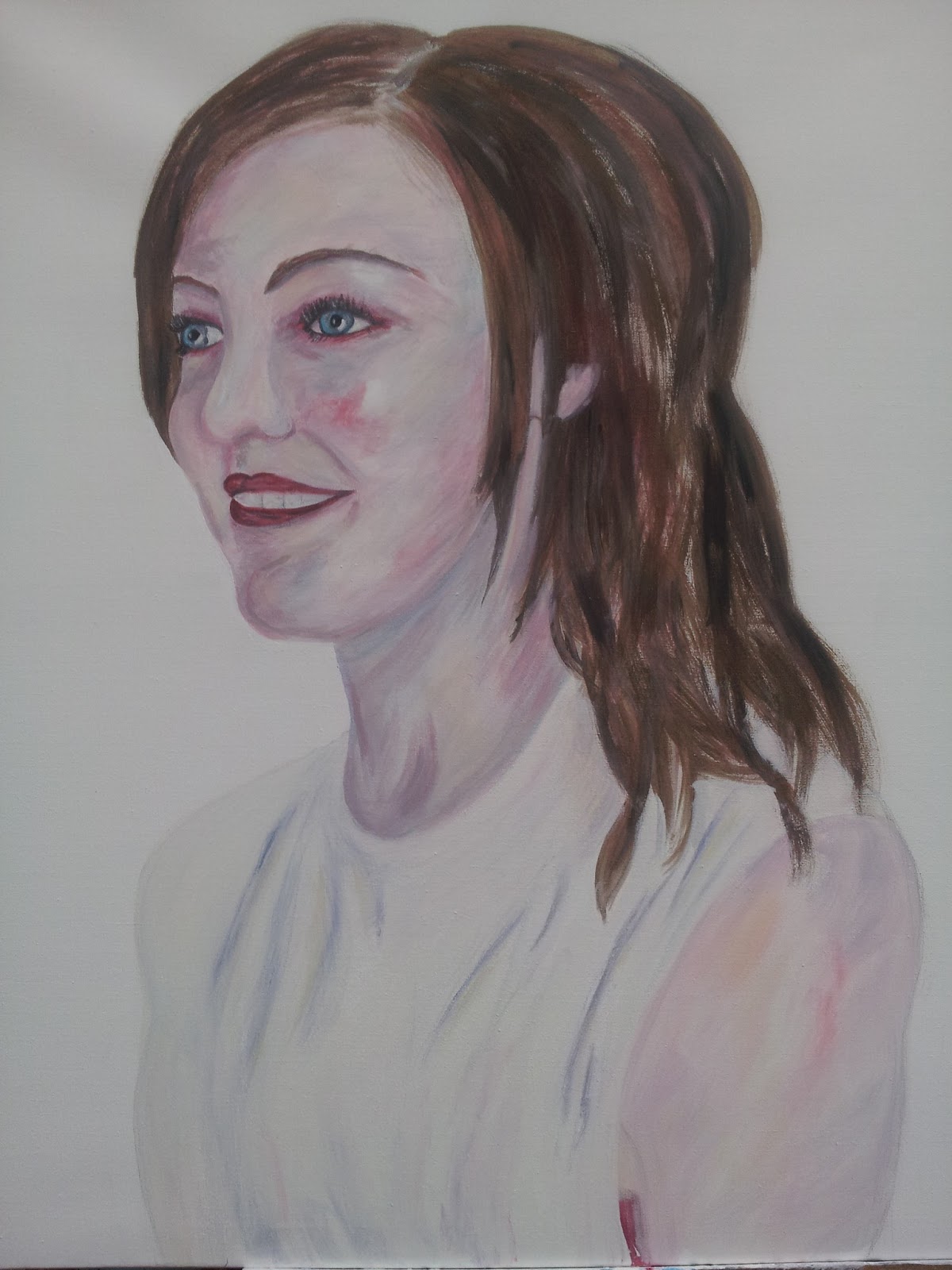
The painting im going to attempt to replicate is this one by Agnes Cecil.

Tuesday, 30 April 2013
Art Nouveau: Clothing and jewelery
Fashion
Men's clothing differed little from preceding periods, although a trend towards less formality continued. A square silhouette, broad, padded shoulders and straight body was typical. New inventions like the zipper found their way into fashion. Women's clothing softened, sleeves became more modest, and a soft, triangular silhouette developed. Later the triangular skirt became cylindrical, producing a narrow, rectangular silhouette. Bodices and skirts were more commonly combined into one-piece dresses, and lighter construction was used. Tailored looks became more popular. Top fashion designers such as Paul Poiret experimented with unusual silhouettes. Soft fabrics like crepe, charmeuse, chiffon, and batiste were popular for tea dresses and evening gowns. Dresses made of lace, or embroidered cotton combined with lace, were fashionable for warm weather. Firmer fabrics such as wool and cotton duck were used for tailored wear.
The art nouveau “look” was at the cutting edge of modern style. Only the most fashionable wore it in its fullest manifestation, while others preferred moderated versions. These styles were spread internationally through fashion journals, such as Les Modes and down through middle-class oriented magazines such as The Ladies Field and La Mode illustrée. Les Modes of July 1902 featured, for example, an art nouveau ball dress by Maggy Rouff with full-length swirls in silver and diamante, on a straw-colored silk ground trimmed with alençon lace.

Maggy Rouff
La Maison Maggy Rouff was one of the great fashion houses, from 1929 to its closure in 1979 . Maggy Rouff nicknamed "the architect of fashion" liked to play on asymmetry. The perfection of his technique from his medical studies, earned him the admiration of his peers and commercial success. After his death in 1971, the House Maggy Rouff perpetuated its innovative designs and colorful prints. Its history and the richness of its range, Maggy Rouff still experiencing a strong reputation in France and abroad.
Jeanne Paquin

Born in Saint-Denis in 1869, Paquin trained as a dressmaker at Rouff and later opened her own fashion house in 1891. The Maison Paquin quickly became known for its eighteenth century-inspired pastel evening dresses and tailored day dresses, as well as for its numerous publicity stunts, including organizing fashion parades to promote her new models and sending her models to operas and races in order to show off her designs. Paquin also frequently collaborated with the illustrators and architects Leon Bakst, George Barbier, Robert Mallet-Stevens, and Louis Süe for the creation of stage costumes, the publication of dress albums and the decoration of her private residences, reinforcing her reputation as a thoroughly modern designer. Beginning in 1912, the her fashions were attractively illustrated in the fashion magazine La Gazette du Bon Ton
Jewelry


Men's clothing differed little from preceding periods, although a trend towards less formality continued. A square silhouette, broad, padded shoulders and straight body was typical. New inventions like the zipper found their way into fashion. Women's clothing softened, sleeves became more modest, and a soft, triangular silhouette developed. Later the triangular skirt became cylindrical, producing a narrow, rectangular silhouette. Bodices and skirts were more commonly combined into one-piece dresses, and lighter construction was used. Tailored looks became more popular. Top fashion designers such as Paul Poiret experimented with unusual silhouettes. Soft fabrics like crepe, charmeuse, chiffon, and batiste were popular for tea dresses and evening gowns. Dresses made of lace, or embroidered cotton combined with lace, were fashionable for warm weather. Firmer fabrics such as wool and cotton duck were used for tailored wear.
The art nouveau “look” was at the cutting edge of modern style. Only the most fashionable wore it in its fullest manifestation, while others preferred moderated versions. These styles were spread internationally through fashion journals, such as Les Modes and down through middle-class oriented magazines such as The Ladies Field and La Mode illustrée. Les Modes of July 1902 featured, for example, an art nouveau ball dress by Maggy Rouff with full-length swirls in silver and diamante, on a straw-colored silk ground trimmed with alençon lace.

From 1895 all the top twenty or so Paris salons were developing art nouveau fashions, from the House of Worth (whose designer was by then Jean-Philippe Worth) through the salons of Doucet, Maggy Rouff, Jeanne Paquin, and Laferriere to cite just a few. They launched season after season of art nouveau-styled garments on to the international fashion market. Examples survive in the great fashion collections of museums in Paris and the United States.
Maggy Rouff
 |
| Maggy modelling one of her own designs |
La Maison Maggy Rouff was one of the great fashion houses, from 1929 to its closure in 1979 . Maggy Rouff nicknamed "the architect of fashion" liked to play on asymmetry. The perfection of his technique from his medical studies, earned him the admiration of his peers and commercial success. After his death in 1971, the House Maggy Rouff perpetuated its innovative designs and colorful prints. Its history and the richness of its range, Maggy Rouff still experiencing a strong reputation in France and abroad.
Jeanne Paquin

Born in Saint-Denis in 1869, Paquin trained as a dressmaker at Rouff and later opened her own fashion house in 1891. The Maison Paquin quickly became known for its eighteenth century-inspired pastel evening dresses and tailored day dresses, as well as for its numerous publicity stunts, including organizing fashion parades to promote her new models and sending her models to operas and races in order to show off her designs. Paquin also frequently collaborated with the illustrators and architects Leon Bakst, George Barbier, Robert Mallet-Stevens, and Louis Süe for the creation of stage costumes, the publication of dress albums and the decoration of her private residences, reinforcing her reputation as a thoroughly modern designer. Beginning in 1912, the her fashions were attractively illustrated in the fashion magazine La Gazette du Bon Ton
Jewelry
In the 1890s, jewellers began to explore the potential of the growing Art Nouveau style and the closely related German, British (and to some extent American) Arts and Crafts Movement.
Art Nouveau jewellery encompassed many distinct features including a focus on the female form and an emphasis on colour, most commonly rendered through the use of enamelling techniques including basse-taille, champleve, cloisonné, and plique-à-jour. Motifs included orchids, irises, pansies, vines, swans, peacocks, snakes, dragonflies, mythological creatures, and the female silhouette.

René Lalique, working for the Paris shop of Samuel Bing, was recognised by contemporaries as a leading figure in this trend. The Darmstadt Artists' Colony and Wiener Werkstätte provided perhaps the most significant German input to the trend, while in Denmark Georg Jensen, though best known for his Silverware, also contributed significant pieces. In England, Liberty & Co. and the British arts & crafts movement of Charles Robert Ashbee contributed slightly more linear but still characteristic designs. The new style moved the focus of the jeweller's art from the setting of stones to the artistic design of the piece itself. Lalique's dragonfly design is one of the best examples of this. Enamels played a large role in technique, while sinuous organic lines are the most recognisable design feature.

Glass making was a domain where art nouveau found a great expression – as example we have the works off Louis Comfort Tiffany in New York, Emile Galle and the Daum brothers in Nancy, France and Charles Rennie Mackintosh in Glasgow.

Monday, 22 April 2013
The holidays are over!
So I spent most of my Easter break in uni. We got the MACCTs floor cloth finished and the tower and arches done too! I didn't go home for Easter but my lovely mum sent me and my little bunny some Easter eggs to Glasgow which was a lovely surprise :)I took the 3rd week off and went home for a few days as my brother was up. Had a few days of seeing friends and family and trying to relax a bit.
Last week I was back in finishing a painting i've been doing for my brothers christmas....last year. I've now decided its a flat warming present for his new investment! It was driving me a little crazy as id been working on it for so long I wasn't enjoying working on it anymore but I got stuck in and came in early a couple of days so it was just me in and I had no distractions,. Finally got it finished on friday, im not 100% happy with it but I think if i spent any more time on it i'd just end up making a mess of it. So i came to my own decision that it was finished, and Matt very kindle reinforced the frame to make it a bit more sturdy. I hope Rowan likes it, im not sure when he's going to get it though...

So back to uni tomorrow, the last stretch. Turns out I only have a few more weeks left as technically im finished my hours and credits in mid May....that's a little scary! Better start churning out the personal projects whilst I can still steal the resources!! Oh and i should probably make a start on my piles of paperwork....Definately don't feel like im leaving in a couple of months....scary!!
 |
| Mumma B is the best! |
 |
| Finished MACCT tower |

So back to uni tomorrow, the last stretch. Turns out I only have a few more weeks left as technically im finished my hours and credits in mid May....that's a little scary! Better start churning out the personal projects whilst I can still steal the resources!! Oh and i should probably make a start on my piles of paperwork....Definately don't feel like im leaving in a couple of months....scary!!
Monday, 15 April 2013
Art Nouveau: Architecture
In Architecture, the Art Nouveau style particularly shows the synthesis of ornament and structure. This type of architecture was characterized by a liberal combination of materials – glass, iron, ceramic and brickwork – which was employed in the creation of interiors in which beams and columns became thick vines with spreading tendrils and the windows became both opening for air and light and membranous outgrowths of the organic whole. It’s safe to say that this approach was surely directed opposed to the traditional architectural values of clarity and reason of structure.


 |
| Constanta city at Black Sea |
Art Nouveau art and architecture
flourished in major European cities between 1890 and 1914.
In the United States, Art Nouveau
ideas were expressed in the work of Louis Comfort Tiffany, Louis Sullivan, and
Frank Lloyd Wright.
Art Nouveau buildings have many
of these features:
- Asymmetrical shapes
- Extensive use of arches and curved forms
- Curved glass
- Curving, plant-like embellishments
- Mosaics
- Stained glass
- Japanese motifs
 |
| Gaudi, Barcelona, Spain |
 |
| Metro Entrance, Paris |
Some examples of Art nouveau can be seen in these buildings...
The Wainwright Building in St. Louis, Missouri, by Louis Sullivan and Dankmar Adlel
- Parque Güell in Barcelona, Spain by Antoni Gaudí
- Majolika Haus in Vienna, Austria by Otto Wagner
- The Municipal House in Prague, Czech Republic
Art Nouveau architects
Hector Guimard was born in Lyon, France, but he studied decorative arts and architecture in Paris, where he later established his own practice. Inspired by some of the new architectural theories circulating in late 1800s, he produced some exceptional avant-garde works. In particular, the radical ideas of French architect Viollet-le-Duc and the sinuous architecture of Belgian Victor Horta greatly influenced his designs.

In 1895, after visiting the first Art Nouveau building, Victor Horta's "Hotel Tassel" in Brussels, Guimard proceeded to a complete re-evaluation of his artistic approach; furniture and interior decoration of a house had to become parts of a total work of art. From 1898 to 1905 he designed and created the station entrances of Paris subway " Le Métropolitain"; they were a fabulous expression of Art Nouveau, the new art, which was discovered during the 1900 World Exposition in Paris.
|
 The architectural and decorative works of Hector Guimard are characterized by fluid, unusual lines, vibrant curves inspired by nature, essential shapes underlined by light and contrast of the different materials used, such as wood, iron and stone. They are the most representatives of the organic and floral Art Nouveau Style in France, and his would later be known as the "Guimard Style". The architectural and decorative works of Hector Guimard are characterized by fluid, unusual lines, vibrant curves inspired by nature, essential shapes underlined by light and contrast of the different materials used, such as wood, iron and stone. They are the most representatives of the organic and floral Art Nouveau Style in France, and his would later be known as the "Guimard Style".Otto Wagner (1841-1918)
studied architecture at the School of Architecture at Vienna Academy, Austria, where he later became a teacher. Among his students were the some renowned art nouveau architects.
 From 1895 he was influenced by new art styles, more suited to the needs of modern way of life and developed his theories on architecture, relating to function, material and construction, in the book "Modern Architecture" (1895). In 1898, he built his first Art Nouveau building, the Majolica House in Vienna, a functional structure with the facade covered in multicolored majolica tiles. He also designed in 1894, the Vienna metropolitan railway system. Otto Wagner was one of the founding members of the Vienna Secession, with fellow artists Klimt, Hoffmann and Olbrich, in 1899. He was one of the most influential artists of the turn of the century : architect, urnbanist, applied artist and theoretician, his writings laid the groundwork for Modernism in architecture. In his architectural works, he was receptive to the use of modern methods of building (steel frame construction) and new materials (thin marble slabs for the façades). |
Louis Henri Sullivan (1856-1924),
American architect, whose brilliant early designs for steel-frame skyscraper
construction led to the emergence of the skyscraper as the distinctive American
building type.
Through his own work, especially his commercial structures, and
as the founder of what is now known as the Chicago School of architects, he
exerted an enormous influence on 20th-century American architecture. His most
famous pupil was the architect Frank Lloyd Wright, who acknowledged Sullivan as
his master.
The son of a dancing teacher, Sullivan was
born in Boston on September 3, 1856. After studying architecture at the
Massachusetts Institute of Technology, he spent a year in Paris at the École
des Beaux-Arts and in the office of a French architect. Settling in Chicago in 1875,
he was employed as a draftsman, then in 1881 formed a partnership with Dankmar
Adler. Together they produced more than 100 buildings. Adler secured the
clients and handled the engineering and acoustical problems, while Sullivan
concerned himself with the architectural designs.
One of their earliest and
most distinguished joint enterprises was the ten-story Auditorium Building
(1886-89) in Chicago. This famous showplace incorporated a hotel, an office
building, and a theater renowned for its superb acoustics. The Wainwright
Building, also ten stories high, with a metal frame, was completed in 1891 in
St. Louis, Missouri.

In 1895 the Sullivan-Adler partnership was dissolved,
leading to a decline in Sullivan's practice. The Carson Pirie Scott (originally
Schlesinger & Mayer) Department Store, Chicago, regarded by many as
Sullivan's masterpiece, was completed in 1904. His architectural practice
declined alarmingly after that; his last buildings are a series of small banks
in the Midwest. All are admired for their superb fusion of bold architectural
forms with Sullivan's characteristic sumptuous ornament. Outstanding are the
Security Bank (originally National Farmers' Bank; 1908) in Owatonna, Minnesota,
and the People's Savings Bank (1911) in Cedar Rapids, Iowa. Concerned with
aesthetics as well as being a working architect, he expressed his ideas in
lectures and writings, including the classic Autobiography of an Idea (1924,
reprinted 1956). His famous axiom, “Form follows function,” became the
touchstone for many in his profession.
Sullivan, however, did not apply it
literally. He meant that an architect should consider the purpose of the
building as a starting point, not as a rigidly limiting stricture. He himself
employed a rich vocabulary of ornament, even on his skyscrapers.
Sullivan's designs often used masonry walls with terra cotta designs.
Intertwining vines and leaves combined with crisp geometric shapes. This
Sullivanesque style was imitated by other architects, and his later work formed
the foundation for the ideas of his student, Frank Lloyd Wright.
Louis Sullivan believed that the
exterior of an office building should reflect its interior structure and its
interior functions.
Charles Rennie Mackintosh (1868 – 1928)
was one of eleven
children, and he suffered from a limp and other health problems. Encouraged to
spend time in the country, he developed a love of nature that later found
expression in his Art Nouveau designs.
With his wife, Margaret MacDonald, Charles Rennie Mackintosh pioneered
modern design in Scotland, and their Art Nouveau works helped lay the
foundation for the Arts & Crafts movement in Britain.
Buildings designed by Charles Rennie Mackintosh are praised for their
elegant detailing and skillful use of light and space.
During his time at the Glasgow School
of Art, Mackintosh was part of "The Four," a group of designers that
included the sisters Margaret and Frances MacDonald and follow artist Herbert
McNair.
"The Four" exhibited posters, graphic designs, and furniture
in Great Britain and Europe. Along with other artists and designers, they
developed the Glasgow Style, known for strong lines and graceful,
symbolic shapes.

Wednesday, 10 April 2013
Art Nouveau
For my Period styles and art history investigation I have decided to research into Art Nouveau. I decided to research this as I find the style beautiful and Im really interested into how it came about and the history behind the movement.
In this investigation I will look into the history, materials and beliefs of the time when the style appeared. I will research into architecture, fine art, fashion, decorative arts, furniture and theatre.

The style of art nouveau can be described as:

In this investigation I will look into the history, materials and beliefs of the time when the style appeared. I will research into architecture, fine art, fashion, decorative arts, furniture and theatre.

Art Nouveau: c 1890-1910
The name ‘Art Nouveau’ came from La Maison de l’Art Nouveau, a shop and interior design
gallery opened in Paris in 1895 by Samuel Bing. There was never any idea that it would
become a generic term but somehow it caught on.
Art Nouveau is the name for the artistic movement that started in Europe around 1890 and lasted until around 1910. It took on many different characteristics in different places, and some of the most famous designers from the era have different styles, including Antoni Gaudi in Barcelona, Josef Hoffmann in Vienna and Carlo Bugatti in Italy. What these designers had in common was an interest in finding a new artistic vocabulary that could best express the modern world.
Art Nouveau, as a movement was remarkable in the way that it spread throughout Europe
and the world. Paris and Britain can be seen as the center of the movement but each country
developed its own interpretation and made it their own to some extent. By the turn of the
century the movement was an international phenomenon but there was no single style- all the
countries demonstrated their own national characteristics. Art Nouveau was also primarily an
urban style and was focused very much on the big cities of the countries it touched.
gallery opened in Paris in 1895 by Samuel Bing. There was never any idea that it would
become a generic term but somehow it caught on.
Art Nouveau is the name for the artistic movement that started in Europe around 1890 and lasted until around 1910. It took on many different characteristics in different places, and some of the most famous designers from the era have different styles, including Antoni Gaudi in Barcelona, Josef Hoffmann in Vienna and Carlo Bugatti in Italy. What these designers had in common was an interest in finding a new artistic vocabulary that could best express the modern world.
Art Nouveau, as a movement was remarkable in the way that it spread throughout Europe
and the world. Paris and Britain can be seen as the center of the movement but each country
developed its own interpretation and made it their own to some extent. By the turn of the
century the movement was an international phenomenon but there was no single style- all the
countries demonstrated their own national characteristics. Art Nouveau was also primarily an
urban style and was focused very much on the big cities of the countries it touched.
In an era of industrialised production, many designers looked to
a local, pre-industrial past for a foundation; in
Russia that was folk tales and folk history, and in France it was the
18th-century 'golden age' of French design. Some artists welcomed technological progress and embraced the aesthetic possibilities of new materials such as cast iron. Others disapproved the shoddiness of mass-produced machine-made goods and aimed to elevate the decorative arts to the level of fine art by applying the highest standards of craftsmanship and design to everyday objects. Working in cities like Paris, Nancy
and Brussels, Art Nouveau designers found greatest inspiration in nature — not necessarily nature's beauty, but
instead its vital force, its never-changing life cycle of birth, life, decay and death.
Nature sometimes took the role of a creepy other-world, governed by dark
uncontrollable forces.
This idea of an uncontrollable world all around us was mirrored in the Art
Nouveau interest in psychology, symbolism and the supernatural.
Sigmund Freud was writing about the unconscious dream world, and artists were
trying to explore that world through art and design.
As always, women were important muses for artists and designers, Art Nouveau woman had a menacing twist. She was alluringly sexual, but also scandalous, morally compromised, even mortally threatening.
As always, women were important muses for artists and designers, Art Nouveau woman had a menacing twist. She was alluringly sexual, but also scandalous, morally compromised, even mortally threatening.
The style of art nouveau can be described as:
- elongated, curvy lines
- the whiplash line
- vertical lines and height
- stylised flowers, leaves, roots, buds and seedpods
- the female form - in a pre-Raphaelite pose with long, flowing hair
- exotic woods, marquetry, iridescent glass, silver and semi-precious stones

Subscribe to:
Posts (Atom)